Solid surface works are used in interior design to create functional, seamless, and visually consistent elements across different spaces. Unlike materials that are limited to standard sizes or shapes, solid surface can be fabricated into customized forms, making it suitable for counters, wall features, vanity tops, tables, sinks, and other interior applications.
In modern interiors, the material is often selected not only for its appearance but also for the design flexibility it provides. Curved edges, integrated components, smooth transitions, and customized dimensions can be developed to suit the requirements of a particular space.
Indiga Solid Surface specializes in solid surface applications where material selection, design detailing, custom fabrication, and installation need to work together. The focus is on creating surface solutions that complement the surrounding interior rather than treating each component as a separate standard product.
Solid surface works involve using engineered solid surface materials to create customized interior components. These materials can be cut, shaped, joined, and finished according to the dimensions and design requirements of a project.
This makes a solid surface particularly useful when an interior requires a combination of practical functionality and a specific visual appearance.
Depending on the project, solid surface can be used for:
The application is not limited to one type of property. The same material can be adapted to different environments by changing its colour, finish, shape, dimensions, and detailing.
The usefulness of a solid surface becomes clearer when looking at how it is applied within an interior. Rather than being used simply as a decorative material, it can become part of the functional elements people interact with every day.
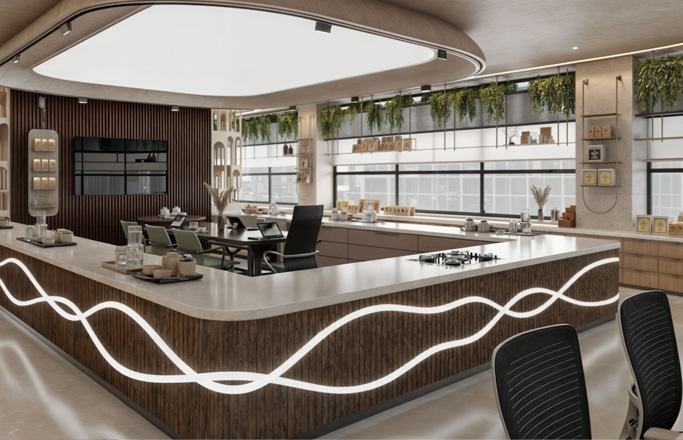
Reception areas are often one of the first parts of a commercial interior that visitors see. The reception counter therefore needs to work as both a functional workstation and a prominent design feature.
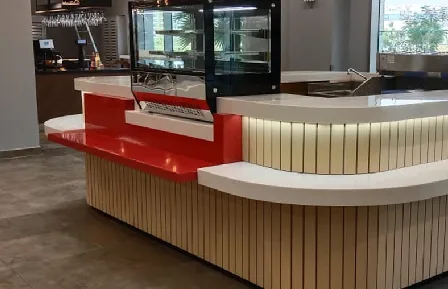
Solid surface allows reception counters to be created in customized sizes and configurations. Designers can incorporate curves, extended surfaces, integrated edges, and other details to create a more distinctive appearance.
The material can also be coordinated with the surrounding wall finishes, flooring, lighting, and joinery. This makes it useful for creating reception areas that feel connected to the overall interior concept.
We provide customized reception counter top solutions where the surface needs to work with the design and dimensions of the surrounding space.
Kitchen and pantry areas require surfaces that can support regular daily activities while fitting naturally into the surrounding cabinetry.
Solid surfaces can be fabricated to match specific counter dimensions and layouts. Cut-outs, edges, corners, and other details can be incorporated according to the requirements of the installation.
In commercial environments, pantry areas may also need surfaces that complement the company’s interior style. In residential spaces, the same principle allows homeowners to select a finish and configuration that suits their kitchen design.
Vanity tops are another common application for solid surfaces. They can be designed around the size of the vanity unit and the available bathroom space.
A customized vanity top can incorporate the required basin opening, edge profile, splashback details, and other design considerations. The result can be a cleaner visual connection between the countertop and the supporting cabinetry.
This makes a solid surface suitable for bathrooms where the vanity is intended to be both practical and visually coordinated with the rest of the space.
Solid surfaces can also move beyond horizontal countertops and become part of vertical interior design.
Wall cladding can be used to create feature walls, reception backdrops, decorative panels, and other visual elements. Instead of relying entirely on paint or conventional wall finishes, a fabricated solid surface can introduce a more refined and continuous appearance.
It can also be incorporated around counters or other interior features, helping different components appear visually connected.
For designers working with branded commercial spaces, this flexibility can be particularly useful when the wall treatment needs to follow a specific design language.
Tables and work surfaces can be designed using a solid surface when a particular dimension, shape, or finish is required.
A standard table may not always suit an unusual room layout or a specific design concept. Custom fabrication allows the surface to be produced according to the intended use and available space.
This can be useful for meeting tables, reception-area tables, work surfaces, hospitality furniture, and selected residential applications.
The ability to create different shapes and edge details also gives designers greater freedom when developing furniture elements as part of the overall interior.
Yes. Solid surface can be used to create sink and bowl applications that are coordinated with surrounding countertops or vanity surfaces.
Instead of treating the sink as a completely separate component, designers can develop it as part of a broader surface concept. This can create a more continuous appearance and help reduce visual interruptions between individual elements.
Sink and bowl applications can be particularly useful in vanity areas, kitchens, pantry spaces, and other interiors where the relationship between the basin and surrounding surface is important.
Lift interiors often have limited dimensions but receive significant daily use. This makes the selection and detailing of interior surfaces important.
Solid surface can be used for lift Interior works and selected interior applications where a customized surface solution is required.
The material can be planned around the available dimensions and coordinated with other elements inside the lift. Colour, pattern, finish, and detailing can be selected to complement the overall building interior.
This allows the lift to be considered as part of the wider interior design rather than as an isolated functional area.
One of the main advantages of a solid surface is its ability to adapt to a design rather than forcing the design to follow a fixed product size.
A project may require a long reception counter, a curved vanity, a specific tabletop shape, or a wall feature with unusual dimensions. These requirements can be addressed through custom fabrication.
Indiga Solid Surface combines design and consultation with fabrication and installation capabilities to develop solutions around the requirements of individual applications.
This approach can be particularly useful when the interior concept includes customized shapes, coordinated finishes, integrated surfaces, or details that are difficult to achieve using standard products.
A solid surface does not always function independently. In many interiors, it becomes the visible surface of a larger built element.
For example, a reception counter may consist of a fabricated solid surface top supported by a customized joinery structure. Similarly, a vanity top can be integrated with cabinetry, while a kitchen surface can be coordinated with storage units and other built-in components.
We can coordinate solid surface applications with fit-out joinery and related interior requirements, helping the finished elements work together as part of the overall design.
This is particularly important when dimensions, colours, edges, and finishing details need to remain consistent across multiple components.
The suitability of a solid surface comes from the combination of design flexibility and practical application.
It can be customized to different dimensions, adapted to various shapes, and produced in finishes that complement different interior concepts. It can also be used across several elements within the same project, helping designers maintain visual consistency.
For a project with multiple customized requirements, using one adaptable surface material across selected applications can simplify the overall design language.
The material can therefore be considered when an interior requires more than a standard countertop or surface product and instead needs a solution developed around the space.
Modern interiors often place importance on clean lines, controlled detailing, integrated features, and visual continuity. Solid surfaces can support these characteristics through customized fabrication.
A curved reception desk, a seamless-looking vanity, a coordinated wall feature, or a specially shaped tabletop can become an intentional part of the interior rather than simply a functional addition.
The material also allows designers to explore different combinations of form, colour, edge detailing, and application. This makes it suitable for interiors where the surface itself contributes to the character of the space.
Solid surface works are used across interior design for much more than conventional countertops. From reception counters, kitchen and pantry tops, and vanity surfaces to wall cladding, tables, sinks, bowls, and lift interiors, the material can be adapted to a wide range of applications.
Its value lies particularly in its ability to support customized dimensions, shapes, finishes, and integrated interior details. When combined thoughtfully with joinery and other design elements, a solid surface can contribute to both the functionality and visual identity of a space.
Indiga Solid Surface focuses on these applications through specialist design consultation, custom fabrication, installation, joinery integration, and related support. This allows a solid surface to be considered as an integral part of an interior rather than simply as a standalone material.
Whether the requirement is a statement reception counter, a coordinated vanity, a customized kitchen surface, a feature wall, or another fabricated interior elements. Indiga Solid Surface team can help develop an approach suited to the space and its design requirements.
Yes, solid surfaces can be custom fabricated for reception counters, front desks, meeting tables, work surfaces, and other furniture elements. Different dimensions, shapes, curves, edge details, and finishes can be incorporated according to the requirements of the interior.
Yes, solid surfaces can be used for sink and bowl applications and can be coordinated with surrounding countertops or vanity surfaces. This can create a more continuous and visually integrated appearance within kitchens, bathrooms, pantries, and other interior spaces.
Yes, solid surfaces can be used for wall cladding, feature walls, reception backdrops, and selected lift interior applications. Its custom fabrication capabilities allow the material to be designed around the available dimensions and overall interior concept.
Solid surface supports customized interior designs because it can be cut, shaped, joined, and finished according to project requirements. This allows designers to create customized dimensions, curved forms, integrated features, edge details, and coordinated surfaces that work with surrounding interior joinery.
September 9, 2026

August 11, 2026

August 10, 2026

August 10, 2026

June 15, 2026
March 12, 2026
March 12, 2026
March 12, 2026

Indiga Interior Design L.L.C., part of Indiga Group, delivers innovative, functional, and timeless interiors across residential, commercial, hospitality, retail, healthcare, and beauty projects worldwide.
Explore Now
As a division of Indiga Group, Indiga Stone provides expertly crafted solid surfaces with fabrication, installation, and project support excellence.
Explore Now
Indiga Interior Design L.L.C., part of Indiga Group, delivers innovative, functional, and timeless interiors across residential, commercial, hospitality, retail, healthcare, and beauty projects worldwide.
Explore Now
As a division of Indiga Group, Indiga Stone provides expertly crafted solid surfaces with fabrication, installation, and project support excellence.
Explore Now